Searching for the best pressure washers for driveways in 2026 usually comes down to one decision: buy a machine or hire someone who already owns the right one. This guide ranks the real options — petrol, electric, cordless, rental and professional power washing — by what each is actually built to handle on Irish driveways, block paving and patios.
- Best overall for oil stains and heavy build-up: hiring a professional power washing service beats buying a machine.
- Petrol pressure washers give the highest PSI for large or neglected driveways but need fuel, storage and servicing.
- Electric pressure washers suit small-to-medium driveways cleaned every few months near a power outlet.
- Cordless pressure washers handle spot cleaning but run out of charge before a full driveway is finished.
- Renting a heavy-duty unit works for a single big clean without buying equipment you'll rarely use again.
Why this matters
A driveway holds more grime than any other outdoor surface around a house — tyre rubber, oil drips, moss, algae and years of rain-driven dirt working into the joints of block paving. The wrong machine either does nothing to it or blasts the sand out from between the blocks.
Most domestic driveway jobs sit in the 1,500-3,000 PSI (100-200 bar) range. Go lower and moss barely shifts; go much higher without knowing your surface and you can strip resin-bound driveways or loosen paving joints. That's exactly why so many Dublin homeowners end up comparing power washing companies for driveways and patios instead of buying a machine they'll use twice a year.
What makes the best pressure washer for driveways
- Pressure rating (PSI/bar) — determines how much force hits the surface, and how much risk to soft paving.
- Flow rate (litres per minute) — more water often clears moss and dirt faster than more pressure alone.
- Power source — petrol, mains electric or battery, each with a different noise, weight and runtime trade-off.
- Hose reach and mobility — a short cable or hose means walking back and forth to an outlet halfway through the job.
- Safety features — auto cut-off, GFCI protection and surface-safe nozzles matter more than headline PSI numbers.
- Surface compatibility — concrete, block paving, gravel-bound and resin driveways all tolerate pressure differently.
At a glance
| Option | Best for | Standout feature | Key limitation |
|---|---|---|---|
| Professional power washing service | Oil stains, heavy build-up, hassle-free driveways | No equipment to buy, fully insured, guaranteed result | Needs a booking, not an instant grab-and-go job |
| Petrol pressure washer | Large or heavily soiled driveways | Highest pressure output, no cable | Noisy, needs fuel storage and servicing |
| Electric pressure washer | Small-to-medium driveways, regular upkeep | Quiet, low maintenance, plug and go | Needs a nearby outlet and a long hose |
| Cordless/battery pressure washer | Quick spot cleaning, no outlet access | Fully portable, no cords | Short runtime, underpowered for a full driveway |
| Rental pressure washer | One-off big clean without buying gear | Heavy-duty unit for a single day | Pickup, return and no operator support |
1. Professional power washing service: best for hassle-free driveways with oil stains and heavy build-up
This is what most people searching "best pressure washers for driveways" actually want: a clean driveway, not a new tool in the shed. A professional crew brings commercial-grade equipment set to the correct pressure for your surface, so block paving joints and resin-bound driveways aren't put at risk. Ecocleansolutions runs this as a standalone power washing service for Dublin homes and businesses, fully insured, with fixed rates and no hidden charges.
Professional power washing pros:
- No equipment to research, buy, store or maintain
- Correct pressure and detergent chosen for the surface, reducing damage risk
- Handles oil stains, moss and years of build-up in one visit
- Backed by insurance and a satisfaction guarantee
Professional power washing cons:
- Requires scheduling ahead rather than doing it the moment you notice moss
- Not the cheapest route for a driveway you'd genuinely enjoy cleaning yourself
Best for: homeowners who want the driveway done properly without owning a pressure washer. Verdict: Buy.
2. Petrol pressure washer: best for large or heavily soiled driveways
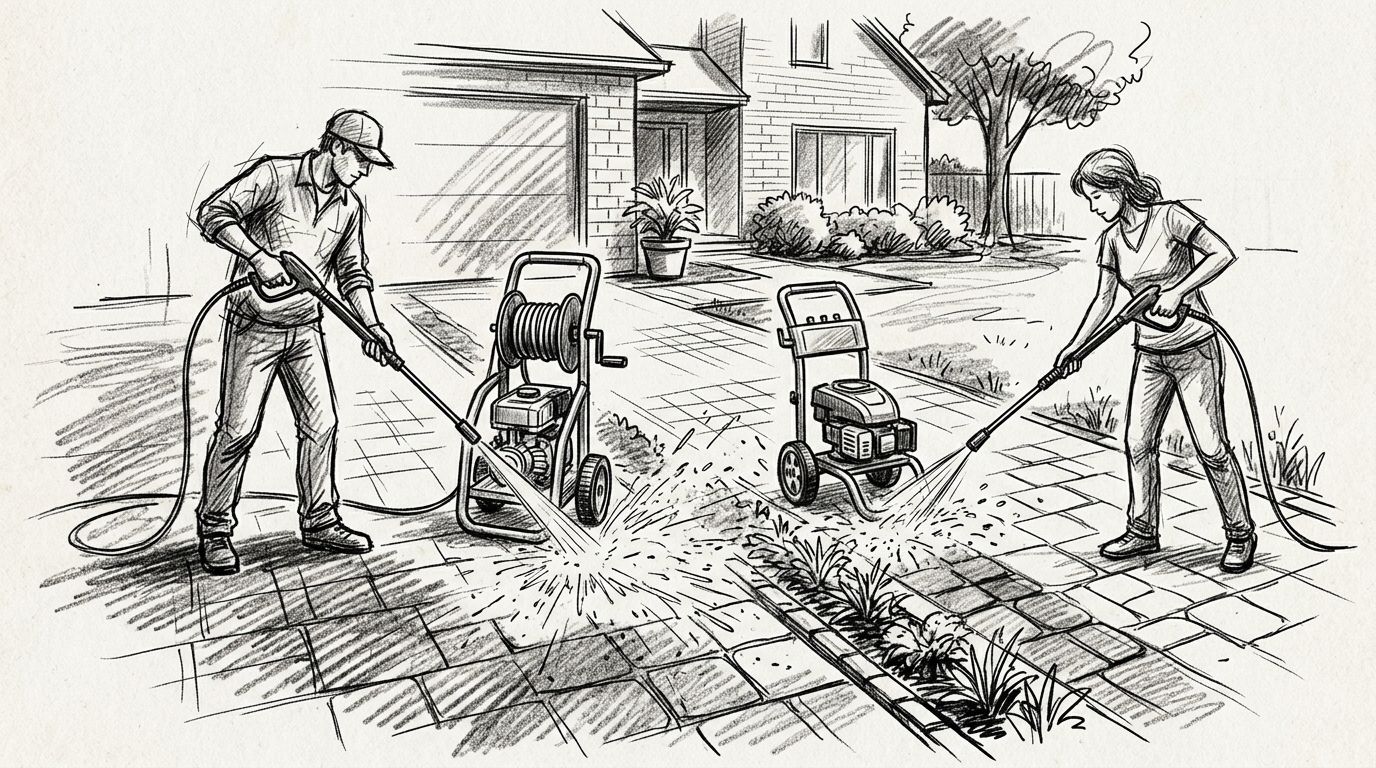
Petrol units deliver the highest pressure and flow rate of any consumer option, which matters on long driveways with years of embedded dirt. They run without a cable, so reach is never an issue, and they handle continuous heavy use better than electric models.
Petrol pressure washer pros:
- Highest PSI and flow rate available to homeowners
- No power cable, so full driveway coverage without stopping
- Built for repeated heavy-duty use
Petrol pressure washer cons:
- Loud enough to bother neighbours on a Saturday morning
- Needs fuel, oil changes and winter storage
- Heavier and harder to manoeuvre than electric models
Best for: large properties with driveways that haven't been cleaned in years. Verdict: Buy.
3. Electric pressure washer: best for small-to-medium driveways cleaned regularly
Electric pressure washers cover most ordinary Dublin driveways well, especially when they're cleaned every few months rather than left for years. They're quiet, light, and start with the pull of a trigger rather than a pull cord.
Electric pressure washer pros:
- Quiet enough for terraced housing and estates
- Low maintenance, no fuel or oil to manage
- Lighter and easier to store than petrol models
Electric pressure washer cons:
- Tied to a power outlet and extension lead
- Lower flow rate than petrol, so heavy build-up takes longer
- Weaker on years-old oil stains
Best for: homeowners doing upkeep cleans on a driveway that's already in decent condition. Verdict: Buy.
4. Cordless pressure washer: best for quick spot cleaning without outlet access
Battery-powered pressure washers are the newest category and solve one specific problem: cleaning somewhere with no power point nearby, like a gate, bin area or a small section of patio. They're not built to cover a full driveway in one charge.
Cordless pressure washer pros:
- No cable, no fuel, fully portable
- Fast to set up for a five-minute job
- Light enough for anyone to carry and use
Cordless pressure washer cons:
- Battery runtime rarely covers a full driveway
- Lower pressure than mains-powered options
- Recharge time between uses adds up on bigger jobs
Best for: small touch-up jobs, not a full driveway clean. Verdict: Hold.
5. Rental pressure washer: best for a one-off big clean without buying equipment
Hardware and tool-hire shops rent commercial-grade petrol units by the day, which suits anyone tackling a driveway once and never again. You get the power of a petrol machine without the ongoing cost of owning one.
Rental pressure washer pros:
- Access to heavy-duty equipment for a single day
- No long-term storage or maintenance commitment
- Cheaper than buying if you'll only use it once
Rental pressure washer cons:
- Pickup and return logistics eat into the day
- No guidance on the correct pressure for your surface
- No comeback if the result isn't what you hoped for
Best for: a single heavy clean before selling or renting out a property. Verdict: Wait — only worth it for a one-off job.
How we ranked these
Each option was measured against the six criteria above: pressure rating, flow rate, power source, mobility, safety features and surface compatibility. The professional power washing service ranks first because it removes the two biggest risks — using too much pressure on the wrong surface, and buying a machine that spends 50 weeks a year in a shed.
Skip the equipment, book the clean
Fully insured Dublin crews, fixed rates, no hidden charges.
Which pressure washer should you choose?
If the driveway has oil stains, moss between the joints, or hasn't been touched in years, a professional power washing service is the safer and faster route in 2026 — the correct pressure gets chosen for you, and the job is guaranteed. For a driveway that's already in reasonable shape and just needs a top-up clean twice a year, an electric pressure washer is the sensible buy. Petrol only makes sense if you're covering a genuinely large area regularly, and rental only makes sense for a single job you'll never repeat.
FAQ
What's the best pressure washer for driveways in 2026?
For most homeowners, hiring a professional power washing service beats buying a machine because the pressure is matched to the surface and the result is guaranteed. For regular DIY upkeep on a driveway in decent condition, an electric pressure washer in the 1,500-2,300 PSI range is usually enough.
Is petrol or electric better for driveway cleaning?
Petrol pressure washers give more PSI and flow rate, which suits large or heavily soiled driveways. Electric models are quieter and lower maintenance, which suits smaller driveways cleaned every few months.
Can a pressure washer damage block paving?
Yes, if the pressure is set too high or the nozzle is held too close, it can strip the sand from between the blocks and loosen them over time. This is one reason many Dublin homeowners hire a power washing service instead of guessing at the right setting.
How often should a driveway be pressure washed?
Once or twice a year keeps moss and algae from building up, though a driveway with years of neglect usually needs a deeper clean first. Regular upkeep cleans are quicker and gentler on the surface than infrequent heavy ones.
Do cordless pressure washers work on driveways?
Cordless models handle small spot cleaning well but rarely have the battery runtime or pressure to cover a full driveway in one go. They're better suited to gates, bins and small patio sections.
Is it worth renting a pressure washer instead of buying one?
Renting makes sense for a single heavy-duty clean, such as before selling a property, since you get commercial-grade power without the ongoing storage and maintenance. For anything you'll repeat every few months, buying or hiring a service works out simpler.
Are professional power washing services safe for block paving and resin driveways?
A professional service sets the pressure and nozzle to match the specific surface, which reduces the risk of stripping joints or damaging resin-bound finishes. This is one of the main reasons the service option ranks ahead of high-PSI petrol machines for delicate surfaces.
One last thing
The number that matters most on a driveway isn't PSI — it's flow rate. A machine with lower pressure but higher litres-per-minute often clears moss and dirt faster and more evenly than a high-PSI unit with weak flow, which is why professional crews tend to size equipment around water volume first and pressure second. If you're set on buying rather than hiring, check the flow rate spec before the PSI number on the box.